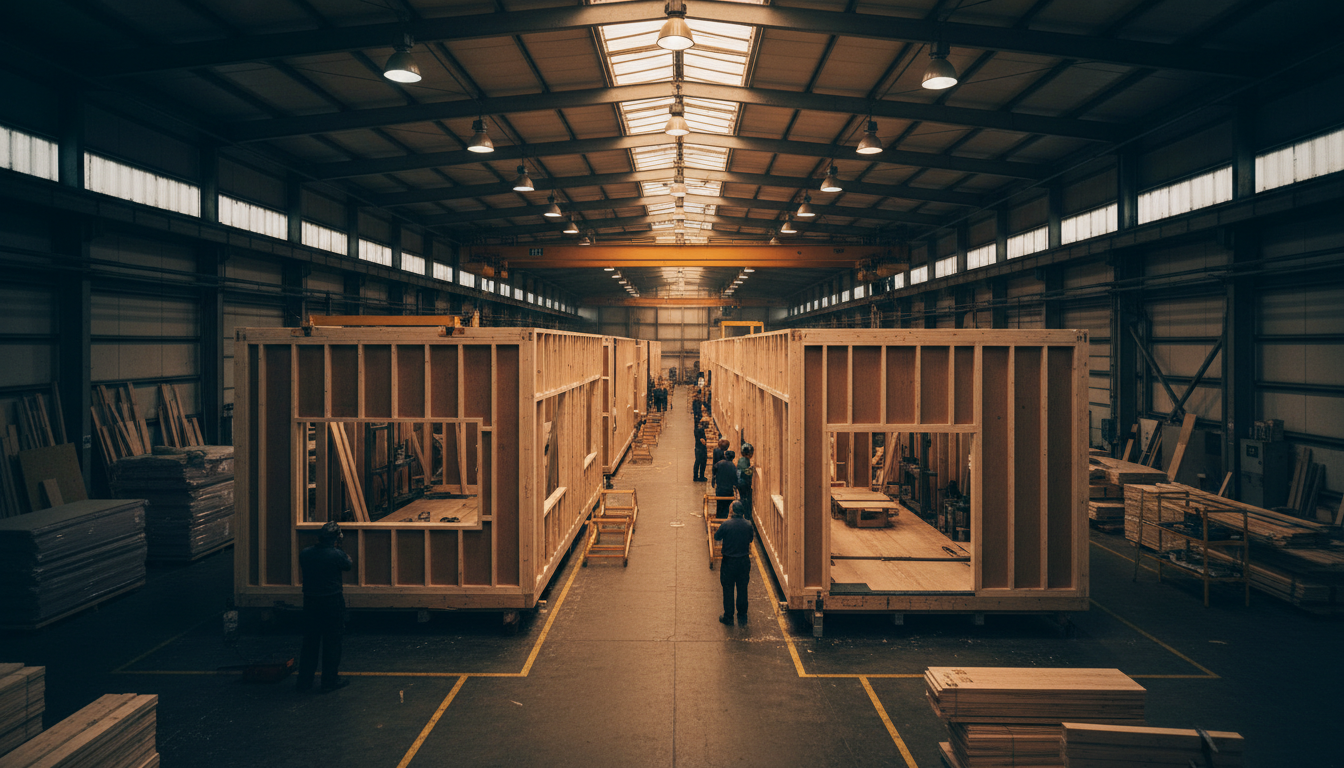
There are certain ideas that capture the imagination of an industry because they promise something every leader desperately wants to believe: that the most difficult problems can be solved by the arrival of a new technology rather than by the uncomfortable work of changing the way the business itself operates. The homebuilding industry has experienced this cycle repeatedly over the past several decades, embracing one external solution after another with the hope that affordability, labor shortages, shrinking margins, and operational complexity will finally be solved by forces outside the organization. Today, modular housing has become the latest object of that fascination, with headlines suggesting that factory-built construction may fundamentally transform residential development and render traditional production homebuilding obsolete.
It is certainly an attractive narrative. If factories can produce homes faster than job sites, labor can be centralized, weather delays can be minimized, and assembly-line manufacturing can replace the unpredictability of field construction, then perhaps the industry’s biggest challenges disappear almost overnight. Investors hear productivity. Politicians hear affordability. Consumers hear lower prices. Builders hear relief.
The problem is that economics are often far less interested in narratives than they are in mathematics.
After spending more than twenty years leading purchasing and operations for some of the largest production homebuilders in America and recently conducting a detailed analysis of companies such as BOXABL and Clayton Homes, I have become convinced that the industry’s conversation is focused on the wrong subject. This is not about whether modular housing has a place in the future of residential construction, because I believe it absolutely does. This whole debate is about whether modular housing solves the problems many builders believe it solves, and the answer becomes considerably more complicated once the conversation moves beyond marketing materials and into the realities of construction economics.
The Most Dangerous Number in Modular Housing Is the One Everyone Talks About
One of the most misleading aspects of the modular housing conversation is the industry’s obsession with advertised factory pricing, because the number that appears in a press release or investor presentation rarely resembles the number that ultimately appears on a builder’s balance sheet. Consumers understandably look at the price of a completed module and assume they are evaluating the cost of a home, while experienced operators understand that they are evaluating only one component within a much larger delivery system that includes transportation, cranes, foundations, engineering, utility connections, permitting, inspections, financing costs, site preparation, installation, and countless other expenses that transform a factory-built product into a completed residence.
When those costs are incorporated into a realistic underwriting model, the economics change considerably. A reasonable estimate for a completed CrossMod or similar modular product installed on a finished lot frequently falls into a direct construction range of approximately $150 to $165 per square foot, excluding land acquisition and horizontal development costs but including the expenses required to actually deliver a finished home. Those figures are not inherently problematic, nor do they suggest that modular construction lacks value. They simply establish a baseline from which meaningful comparisons can begin, because builders do not compete on advertised factory pricing. They compete on delivered economics.
The Builders Everyone Thinks Modular Will Replace May Already Be Too Efficient
Perhaps the most surprising realization that emerged from my analysis had nothing to do with modular construction itself and everything to do with how dramatically the market underestimates the operational sophistication of America’s largest production builders. There remains a persistent assumption that large public builders succeed primarily because of scale, access to capital, or favorable land positions, when in reality many of their greatest competitive advantages have been built quietly over decades through relentless improvements in purchasing, product development, scheduling, supplier relationships, value engineering, and operational discipline.
Based upon years of firsthand experience across multiple national builders and markets throughout the Sun Belt, I believe highly optimized production builders frequently achieve direct vertical construction costs in the neighborhood of $85 to $90 per square foot on finished lots, with some products and markets performing even better. Another useful industry heuristic suggests that direct construction costs generally represent approximately 40 to 50 percent of the ultimate retail sales price, a relationship that has remained remarkably consistent across many production operations. Those numbers are rarely discussed outside executive conference rooms, yet they explain why some of the industry’s largest organizations continue producing strong returns despite operating in highly competitive markets.
Once those economics are placed alongside the estimated installed costs associated with modular construction, an obvious question begins to emerge.
If the best production builders in America are already constructing homes for roughly $85 to $90 per square foot while many modular alternatives approach $150 to $165 per square foot after installation, transportation, and site costs are fully recognized, then what exactly is modular housing replacing?
The Economics Suggest That Modular Competes on Constraints, Not Cost
The answer to that question is important because it forces the conversation away from headlines and back toward strategy. If modular construction cannot consistently outperform elite production builders on direct construction cost, then its long-term value proposition must exist somewhere else. Rather than competing on raw dollars per square foot, factory-built construction may derive its greatest advantages from reducing labor uncertainty, compressing construction schedules, accelerating capital turns, minimizing weather delays, improving production predictability, and allowing projects to proceed in markets where skilled labor is either unavailable or prohibitively expensive.
Those are meaningful advantages, and they deserve serious consideration by every builder evaluating future construction methods. They simply represent a different competitive advantage than the affordability revolution often described in public discourse. Cost leadership and operational predictability are not interchangeable concepts, and confusing one for the other leads to unrealistic expectations about what modular housing can realistically accomplish.
Viewed through that lens, the industry’s future appears less like a wholesale replacement of site-built construction and more like an intelligent integration of industrialized components into already sophisticated operating systems.
Ironically, Modular May Disrupt the Bottom Half of the Industry Before the Top
One of the more fascinating implications of this analysis is that modular housing may ultimately create the greatest disruption in precisely the segment of the market that receives the least attention. The largest national builders have spent decades refining their purchasing organizations, engineering cost reductions and building operational systems capable of extracting incremental savings across thousands of annual closings. Replacing those systems would require modular construction to overcome an extraordinarily high economic hurdle.
The challenge looks very different for builders producing fifty, one hundred, or even five hundred homes annually. Smaller organizations often operate with less purchasing leverage, higher overhead allocations, weaker supplier relationships, greater labor volatility, and less standardized production systems. In those environments, modular construction may indeed represent a transformative opportunity because it is not competing against extraordinary operational excellence. It is competing against inefficiency.
That distinction may ultimately define the future of factory-built housing far more than any technological breakthrough.
The Real Lesson Has Nothing to Do With Modular Housing
What makes the current conversation particularly interesting is that it reflects a broader pattern that has existed within homebuilding for years. At various moments the industry has convinced itself that lower interest rates would restore profitability, that supply chains would eliminate cost pressures, that government intervention would solve affordability challenges, that artificial intelligence would revolutionize operations, or that some external force would finally remove the obstacles preventing builders from achieving better results.
Meanwhile, the highest-performing organizations quietly continued doing what they had always done. They refined products. They renegotiated supplier contracts. They redesigned floor plans. They reduced waste. They improved schedules. They developed stronger leaders. They strengthened accountability. They engineered costs out of their homes one decision at a time rather than waiting for a breakthrough that would allow them to avoid making difficult operational improvements.
The difference between average builders and exceptional builders has rarely been access to technology. More often, it has been the willingness to improve relentlessly while competitors wait for circumstances to improve on their behalf.
The Most Powerful Margin Improvement Available to Many Builders Costs Nothing More Than Better Execution
Consider a builder producing one hundred homes annually with an average size of approximately 2,500 square feet. That organization constructs roughly 250,000 square feet of housing every year, meaning that every single dollar of direct cost reduction achieved through purchasing, product engineering, or operational improvement creates approximately $250,000 of additional annual profit. A two-dollar improvement approaches half a million dollars, not because of financial engineering or technological disruption but because disciplined execution compounds across meaningful volume.
Those economics explain why elite production builders devote extraordinary attention to details that many observers dismiss as insignificant. A better window package, a redesigned foundation detail, a standardized framing plan, or a stronger supplier agreement may never generate headlines, yet each contributes to a business model capable of creating millions of dollars in long-term value. Operational excellence rarely appears revolutionary in isolation, but aggregated across thousands of decisions it becomes extraordinarily difficult to compete against.
The Question Every Builder Should Be Asking Is Far More Important Than Whether Modular Wins
I have little doubt that factory-built construction will occupy a larger role within homebuilding over the next twenty years, and I would not be surprised to see increasing adoption of wall panels, bathroom pods, roof assemblies, mechanical modules, and other hybrid construction methods that combine manufacturing efficiency with site-built flexibility. I also believe companies such as BOXABL and Clayton Homes will continue pushing the industry toward greater industrialization, creating innovations that deserve close attention from every serious operator.
What I do not believe is that modular housing will rescue builders who have failed to build disciplined operating platforms.
History suggests that organizations capable of generating sustainable value rarely become successful because they correctly predicted the next innovation. They became successful because they built cultures, systems, leadership teams, and operating disciplines capable of adapting regardless of which innovation ultimately prevailed.
The homebuilding industry continues asking whether modular housing will change the future of construction. I believe the more important question is whether builders are willing to do the far more difficult work of improving the businesses they already own, because operational excellence has quietly outperformed technological optimism for decades, and there is remarkably little evidence to suggest that reality is about to change.