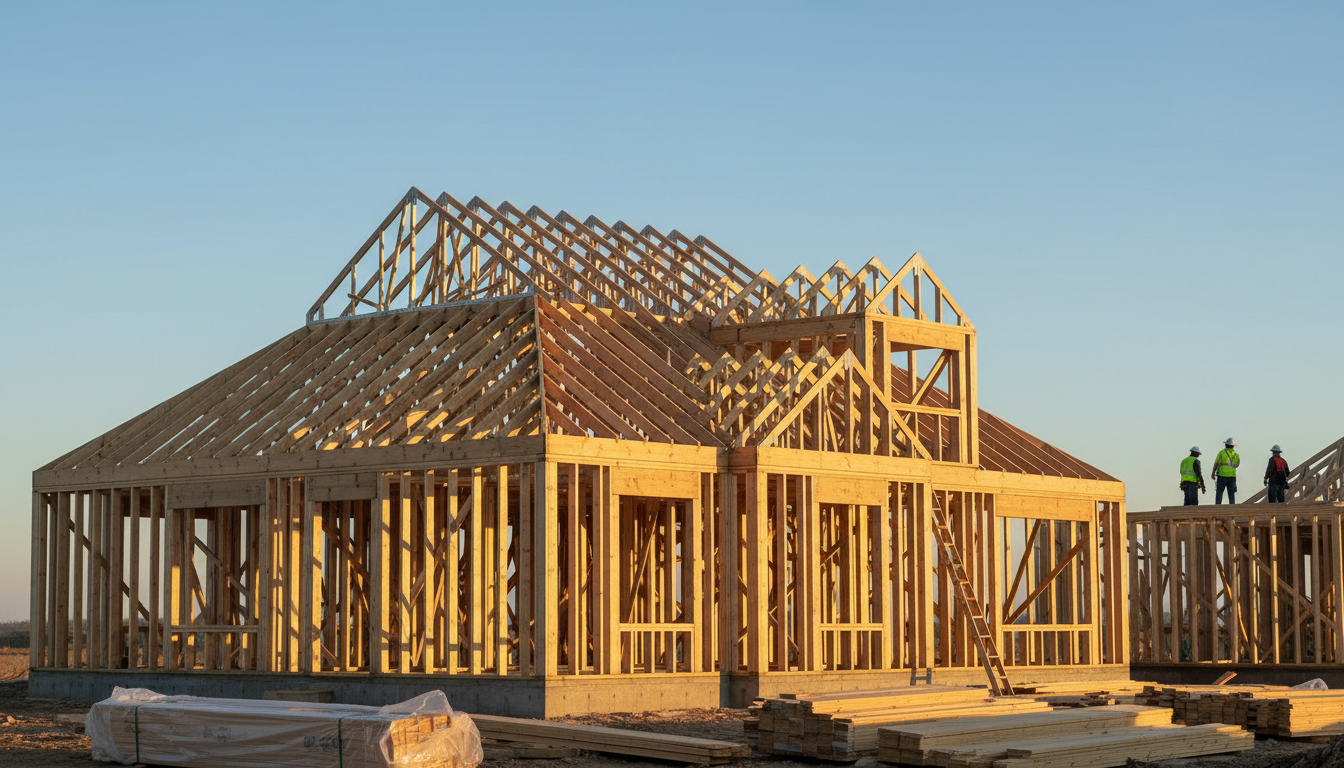
There is a conversation happening across the homebuilding industry right now about affordability that sounds serious on the surface yet continues to miss the most controllable and most consequential variable builders actually have, which is not interest rates, not land pricing, not even labor volatility, but the structural design discipline embedded in how homes are framed from the very beginning.
Builders are talking about affordability constantly, yet most are still directing their operational energy toward finishes, upgrade paths, and design-center strategy rather than confronting the structural inefficiencies that quietly add thousands of dollars to every home before drywall is ever installed.
This is not an abstract critique; it is a recurring operational reality that shows up in plan meetings, budget breakdowns, and margin reviews across markets, where teams debate cosmetic differentiation while structural cost drivers remain largely unchallenged.
The Real Product Cost Lives in the Structure
One of the most important realities builders must internalize is that construction cost is heavily concentrated in a small group of front-end trades, and until organizations begin treating those trades as strategic design variables rather than downstream execution functions, affordability will remain an unsolved internal problem rather than an external constraint.
The structural cost concentration consistently includes:
- Foundations
- Framing
- Mechanical trades
- Roofing
- Windows
Together, these trades typically account for roughly half of the total cost of a home, even though they represent only a fraction of the total number of trades involved in construction.
When viewed through the lens of retail pricing, this concentration becomes even more consequential, because in many markets direct construction cost represents 30 to 50 percent of the final sales price, meaning that structural trade decisions alone can influence approximately 15 to 25 percent of total home value.
Framing sits at the center of this system, not just as a trade but as the structural translation of architectural ambition into material reality, shaping how every other system interacts with the home.
Builders Are Still Designing Complexity and Calling It Innovation
One of the most consistent operational frustrations is watching builders introduce structural complexity during the architectural phase under the assumption that differentiation must be visible to be valuable, which leads to plan series that vary unnecessarily in core layouts, roof geometry, and structural spans even when those variations provide little meaningful benefit to the buyer.
This pattern produces predictable consequences:
- Framing waste increases due to irregular geometry
- Mechanical coordination becomes more difficult
- Trade pricing variability rises
- Cycle times become less predictable
- Margin pressure is blamed on market conditions
By the time these outcomes become visible in cost reports, the structural decisions responsible for them are already embedded in the product.
Why the Most Disciplined Builders Think About Framing First
The more operationally disciplined builders do not begin product development with finishes or marketing narratives; they begin with structural logic, recognizing that framing discipline is one of the most powerful levers available for controlling both cost and constructability.
These builders tend to:
- Develop repeatable structural grids across plan series
- Standardize core layouts such as kitchens and primary suites
- Simplify rooflines to reduce waste and labor variability
- Involve framing trades early in design discussions
- Test product platforms against cost models before scaling
This approach does not eliminate design quality; it ensures that design is supported by an economically viable structural framework.
Smaller Builders Do Not Need Scale to Win This Battle
There is a persistent belief among smaller production builders that structural standardization is only feasible at national scale, yet the reality is that operational learning compounds regardless of volume when leadership commits to consistency in the structural elements that matter most.
When smaller builders adopt framing discipline as a strategic priority, they gain tangible advantages:
- More predictable construction schedules
- Reduced material waste
- Improved trade productivity
- Stronger cost forecasting accuracy
- Greater margin resilience
The competitive gap is not created by size alone but by the willingness to treat framing as a design strategy rather than as a downstream trade function.
Technology Will Not Fix Structural Indiscipline
There is growing enthusiasm across the industry for digital estimating tools, prefabrication systems, and emerging construction technologies, yet none of these innovations can compensate for framing inefficiencies embedded in the product during the design phase.
If a home is structurally inefficient, advanced takeoff software will simply quantify that inefficiency more accurately, and prefabrication will assemble it more quickly without changing the underlying cost structure.
Affordability gains must therefore begin with structural clarity rather than execution speed.
The Affordability War Will Be Won in Structural Plans, Not Showrooms
As market conditions evolve and margin pressure intensifies, the builders who succeed will be those who recognize that affordability is fundamentally a structural design problem, one that must be addressed before marketing strategy, finish selection, or sales positioning enter the conversation.
Builders who continue to focus primarily on cosmetic differentiation will remain trapped in reactive cost cycles, while those who embed framing discipline into their product development process will gain a strategic advantage that compounds across communities and market cycles.
The industry does not lack awareness of affordability challenges; it lacks alignment around where the real leverage exists, and until framing becomes a non-negotiable focus in product strategy, builders will continue fighting the affordability war on the wrong front.


